
Two smiling people wearing festive outfits with accessories and confetti around them
A clear blue sky with a few scattered white clouds

ALCAZAR Paris, a legendary venue

The history

Some addresses have a history. ALCAZAR has a legend.

At 62 rue Mazarine, eras have come and gone without ever erasing the venue’s essential purpose: bringing people together, entertaining, surprising and allowing ideas to circulate.

From the building’s earliest lives to the flamboyant nights of Jean-Marie Rivière, from the artists who emerged on its stage to the personalities who came here to meet, ALCAZAR belongs to the memory of Saint-Germain-des-Prés.

A house where Paris revealed its freest side.

And whose story has never stopped changing.

A man in a suit is sitting at a desk, hands clasped, in a workspace filled with books and documents.
THE BEGINNINGS

Long before the nights of ALCAZAR

The story of 62 rue Mazarine begins several centuries before the first feathers appeared.

In the 17th century, the site housed a jeu de paume, a place where people already came to be entertained, meet and be seen.

The building later took on another life, Liened to printing and the circulation of ideas.

The show had not yet taken the stage, but the venue already possessed what would come to define it: movement, sociability and a certain Parisian energy.

It would take until the 20th century for the story to become more nocturnal. And considerably more flamboyant.

Three people in the air in a bright setting, holding rackets, likely playing badminton.
THE BEGINNING OF A LEGEND

1968: Jean-Marie Rivière awakens rue Mazarine

In 1968, Jean-Marie Rivière opened the doors of ALCAZAR Paris.

An actor, director and music-hall impresario with an instinctive sense of celebration, he was instantly recognisable in his white suits. But he did far more than produce shows: he created entire worlds, composed tableaux and turned every evening into an experience in which the guests themselves became part of the performance.

Under his direction, ALCAZAR broke away from the conventions of traditional cabaret.

The acts combined song, dance, humour, provocation and transformation. Costumes played with appearances. Artists challenged identities and reversed roles.

With revues such as Les Dessous de la nuit, Jean-Marie Rivière invented another way of experiencing music hall: freer, bolder and deeply rooted in its time.

ALCAZAR looked like nowhere else. Very soon, many others would try to look like ALCAZAR.

A group of dancers in tutus performs a choreography on stage under spotlights.

A stage for freedom

At ALCAZAR, transformation was not simply a stage effect. It became a language.

In the Paris of the late 1960s, the cabaret offered a rare space to artists who challenged representations and refused identities that were too neatly defined. On stage and in the room, boundaries blurred between genders, generations and social circles.

People came to see the show, but also to discover a society that felt freer, more exuberant and more open than the one waiting outside. The venue became a refuge for independent spirits, a creative laboratory and one of the great meeting places of the Left Bank.

Celebrities and anonymous guests shared the same nights, in an atmosphere where everyone could watch everyone else — and choose, for a few hours, to become someone different.

At ALCAZAR, freedom was never announced. It simply walked on stage.

Two smiling people wearing festive outfits with accessories and confetti around them
THE ICONS OF MAZARINE STREET

Marie-France, Dani and the faces of the night

ALCAZAR attracted personalities who were already famous, but it also knew how to reveal new ones.

In 1969, at just 18 years old, Marie-France joined the cabaret. Somewhere between humour and glamour, she shaped a singular persona there for almost fifteen years, notably through her portrayal of Marilyn Monroe.

Singer, actress and avant-garde figure, she became one of the most emblematic faces of the house.

Alongside her, Dani emerged as an androgynous, mischievous and thoroughly modern revue leader. Her cropped hair, style and stage presence captivated Paris society.

Other artists also contributed to those flamboyant years. Dalida notably appeared on the ALCAZAR stage as Sally Bowles, the heroine of Cabaret.

Cinema also made use of the setting: in 1973, filmmaker Rainer Werner Fassbinder shot several scenes of Le Monde sur le fil there.

The house did not simply welcome its era. It helped give that era a face.

A series of silhouettes of dancers in motion, lit by spotlights, in a dark setting.
History · Since 1968

The whole world came through rue Mazarine

Over the years, ALCAZAR became one of the most sought-after destinations in Paris nightlife.

The house’s artists performed before Josephine Baker, Liza Minnelli, David Bowie, Johnny Hallyday, Sylvie Vartan, Gina Lollobrigida, Marisa Berenson and Roger Vadim. Some evenings went straight into the archives.

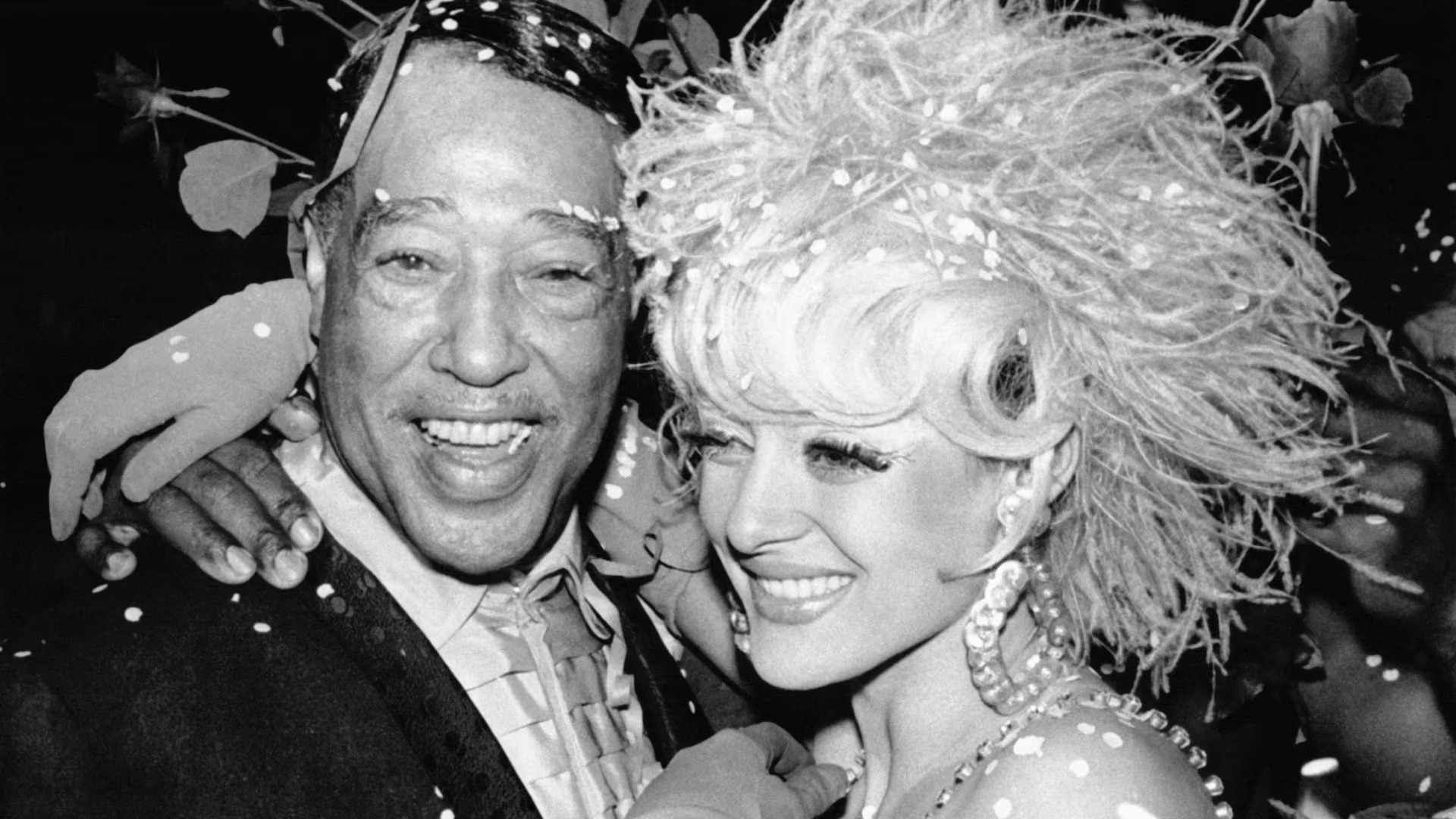
On 20 November 1969, Duke Ellington came to celebrate his 70th birthday. In 1972, Liza Minnelli posed alongside Jean-Marie Rivière. David Bowie came to ALCAZAR after his Paris concert in 1976.

Three years later, Queen received a gold record there before performing on stage.

Mickey Rooney, Charles Bronson, Peter Fonda, Sergio Leone, Marcello Mastroianni, Catherine Deneuve, Serge Gainsbourg and Jane Birkin were also among the faces immortalised on rue Mazarine.

They did not come simply to watch a revue.

They came to join a night that all of Paris would be talking about the next day.

A group of people in formal attire celebrate with paper garlands, some smiling and appearing joyful.
Johnny Hallyday & Sylvie Vartan
Duke Ellington 70 ans
Three people sitting at a festive table, one of them holding a bottle of Moët et Chandon champagne.
David Bowie
Six people pose together in front of a metallic background, some smiling and gesturing.
Dalida
Two musicians on stage, one singing into a microphone and the other playing an electric guitar, under spotlights shaped like bright dots.
THE LEGEND CROSSES THE ATLANTIC

From Paris to Las Vegas

ALCAZAR’s reputation soon spread far beyond Saint-Germain-des-Prés.

In 1980, the house crossed the Atlantic. Artists, costumes and sets travelled to the Desert Inn in Las Vegas for an exceptional show.

The adventure confirmed the international influence of a Parisian cabaret whose aesthetic, audacity and taste for transformation had inspired many other stages.

ALCAZAR had now become part of a certain mythology of nightlife: that of places whose name alone is enough to conjure up lights, silhouettes and memories.

What history tells us. And what legend prefers to keep to itself.

A place lived with such intensity will always create stories of its own.

Jacques Brel placed ALCAZAR in popular culture by mentioning it in Les Remparts de Varsovie. Other, more elusive stories travelled from night to night.

The most famous concerns Jim Morrison and the neighbouring Rock’n’Roll Circus. The story tells of the singer passing through the backstage areas and corridors Liening the establishments on the night of his death.

That version has never been established and should remain exactly what it is: a legend of Paris nightlife.

ALCAZAR does not need every story told about it to be true in order to have left its mark on the imagination.

But its history deserves never to confuse facts with the shadows they have left behind.

Five men pose in front of a neon sign "L'Alcazar Die Paridis" with gold and platinum discs at their feet.
ALWAYS ON THE MOVE

A venue that has never stopped changing

As Paris evolved, ALCAZAR reinvented itself.

In 1998, British designer Sir Terence Conran transformed the former cabaret into a large contemporary brasserie. Beneath the twelve-metre-high glass roof, guests continued to dine, meet and keep the night alive, now in a more minimalist setting.

In 2015, interior designer Laura Gonzalez imagined another transformation. Velvet, bronze screens, contemporary art and abundant greenery reshaped the room in the spirit of a hanging garden.

The settings changed. So did the ways people used them.

But ALCAZAR remained a place where dining, architecture and Parisian life came together.

with Walter Butler

A new chapter begins

An entrepreneur and investor, Walter Butler founded Butler Industries in 1991 after a career in senior government service and finance. For several years now, he has also been developing a collection of brands centered on the French art of living, which are now brought together under the Butler Collection.

This “house of houses” brings together venues and brands, each with a strong identity, ranging from gastronomy to entertainment and hospitality. Pierre Hermé Paris, L’Ambroisie, and the Paradis Latin are among its best-known names. L’ALCAZAR now joins this collection, driven by the same vision: to preserve what gives a place its character while equipping it to keep pace with the times.

On Rue Mazarine, the goal is not to reenact the 1970s. The venue is bringing back the stage, the music, the dining experience, and the party, while retaining from its history what remains most relevant today: the spirit of freedom, a taste for boldness, and a certain vision of Parisian nightlife.

The artists have changed. Paris has too. But the curtain still rises at 62 Rue Mazarine.